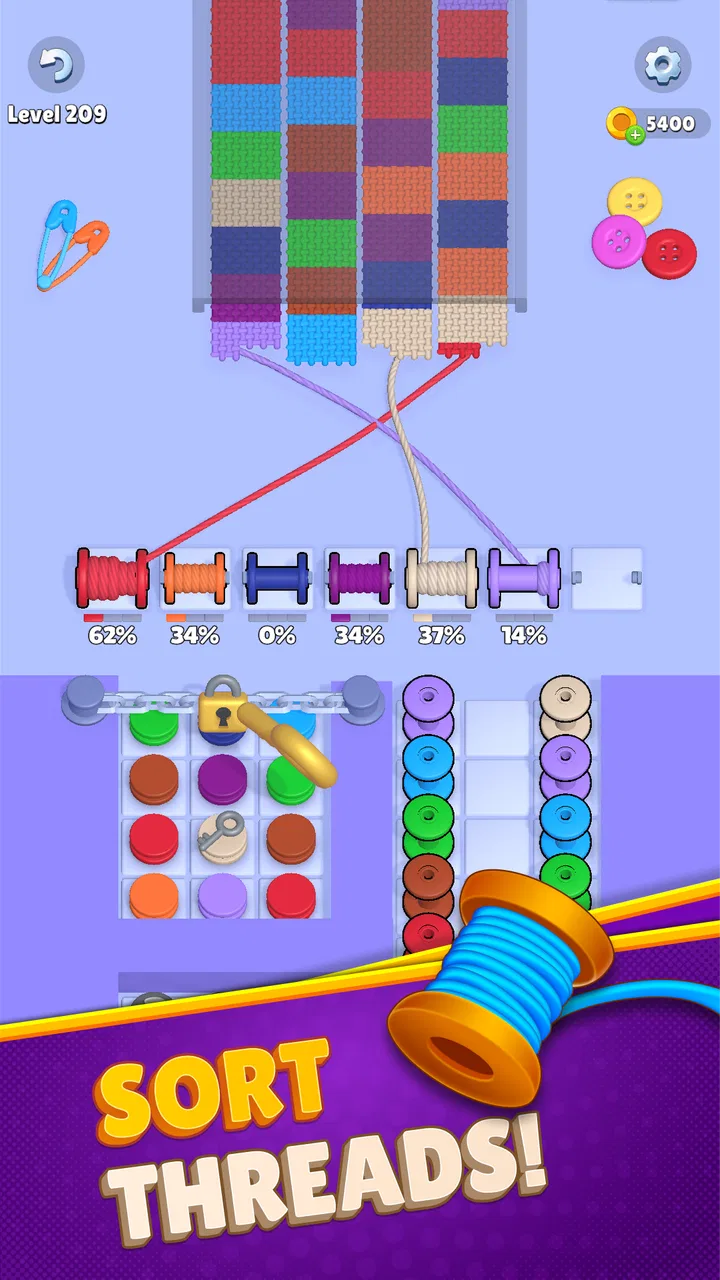
Knit Out
- 4.6
- Rating
- 1.00M
- Installs
- Free
- Price

 Analysis by App-foxy
I went into Knit Out expecting a simple puzzle game, and that is exactly where its appeal begins. Made by Rollic Games, it turns the idea of untangling knitted pieces into a hands-on mobile activity: I look at the arrangement, decide which move should come first, make the connection, and immediately see whether that choice has opened the next useful path. It is easy to understand without a long tutorial, but the small decisions become more interesting once a level stops offering an obvious first move.
This is a free puzzle game for Everyone, available on Android devices running version 7.0 or later. It was released on March 6, 2025, and the current version is 1.18.1. The store page shows a 4.5 average from around 57 thousand ratings, while the game has passed 1 million installs. Those figures suggest that the concept has found a broad audience, but they do not replace the more important question: does the actual play loop stay satisfying after the novelty of the knitted theme wears off?
How the untangling loop feels in real play
I focus on how the untangling loop rewards deliberate choices, including a practical way to treat each move as a chance to learn rather than merely advance. I also consider where that steady, visual problem-solving style fits among mobile puzzles, and where a more varied game may be a better match.
You May Also Like

 Blood Strike: 2.5 Anniversary
Blood Strike’s Loadouts Turn Every Drop Into a Tactical Gamble
A close look at Blood Strike’s custom loadouts: how fast access to signature weapons reshapes its battle royale rhythm, rewards preparation, and narrows the gap between fights.

 Pandora - Music & Podcasts
Pandora’s Music Is Easy to Start, but Harder to Recover
Pandora’s strength is its low-effort path from a seed to a station. Its weak spot is how much confidence it asks you to place in connection, setup, and quiet recovery.

 8 Ball Pool
 Is Built on Rivalries, Rematches, and Routine
A close look at the rivalries, rematches, shared routines, and unanswered safety questions that turn a quick pool match into a persistent mobile community.

 Samsung Music
’s Quiet Strength Is Playing What You Already Own
Its reach comes less from spectacle than from dependable access to a personal library. That simplicity is both the app’s strongest retention engine and its ceiling.

 AccuWeather: Weather Radar
AccuWeather Review: A Quick, Clear Forecast for Everyday Decisions
For everyday plans, the best forecast is the one you can understand quickly. AccuWeather makes rain timing, radar, and local conditions easy to act on, with a few trade-offs.

 Hill Climb Racing
Why Hill Climb Racing Still Turns Crashes Into One More Run
A tiny car, a bumpy hill and one more upgrade: Hill Climb Racing keeps resurfacing because its simple chaos makes every near-miss feel personal.
More From Our News Desk
View All News


The first action is easy, but choosing it well matters
The best part of the opening move is that Knit Out does not ask me to learn a complicated control scheme before I can enjoy it. The interaction is direct, and the visual arrangement does most of the explaining. I scan the pieces, identify what seems blocked, and try to free a section without making the remaining layout harder to read. That makes the game approachable for someone who normally avoids puzzle titles with dense instructions.
There is also a useful difference between seeing a possible move and seeing a good move. A quick tap may remove one obstruction, but it can leave a less convenient arrangement behind. When several threads or knitted sections appear to compete for the same space, I have to think one step ahead rather than simply react to the most visible option. That is where the game moves beyond a decorative theme and becomes a genuine spatial puzzle.
I found it useful to pause for a few seconds before touching anything. The first visual impression can make a level look more tangled than it really is. Looking for an outer piece, a loose end, or a connection that is clearly preventing another section from moving gives me a workable starting point. This is a small habit, but it reduces random tapping and makes the solution feel earned.
That opening also makes the game suitable for short breaks. I can begin a level without committing to a long campaign or a complicated setup. A person waiting for a train, taking a short lunch break, or winding down before bed can understand the board quickly and start making progress. The trade-off is that anyone looking for a deep story, character development, or a large strategic system will not find that kind of structure here.
Feedback keeps each move readable
Once I make a move, the feedback is the main reason I want to continue. A successful action changes the arrangement clearly enough for me to understand what has been freed and what remains. That immediate response creates a pleasant rhythm: inspect, act, watch the puzzle simplify, then inspect the new shape. The game does not need a long explanation after every decision because the board itself communicates the result.
This rhythm is especially important in a puzzle based on untangling. If the visual response were vague, I would have to remember too much information between moves. Instead, each change helps me update my mental map. I can tell whether I have genuinely improved the position or merely shifted the problem somewhere else. That makes the experience feel more tactile than a standard matching puzzle, even though the underlying activity is still built around careful choices.
One of my more effective approaches was to treat every move as information rather than only as progress. If a piece does not produce the result I expected, that tells me which areas are connected or blocked. I then use that discovery to plan the next action. This is a better way to handle a stubborn level than repeatedly selecting the same attractive-looking section and hoping the board will somehow resolve itself.
The feedback also supports a calm style of play. I do not need to rush to keep up with a timer in the moments when I want to think. That makes Knit Out a good fit for players who enjoy visual order and gradual problem solving. It is less suitable for someone who wants the constant pressure of an arcade puzzle, where speed and reflexes matter as much as planning.
The reward is the cleared shape, not just the completion screen
The strongest reward in Knit Out is the transformation of the board. At the beginning, the arrangement looks crowded and resistant. After a sequence of correct decisions, the same space becomes easier to read, and the final release gives the session a clear sense of completion. I like that the satisfaction comes from seeing the structure make sense rather than from needing a complicated narrative reason to move forward.
That visual reward works because the action and result are closely connected. I am not completing an unrelated mini-game to earn progress in a separate menu. The thing I manipulate is the thing that changes. For a puzzle player, that direct relationship is more convincing than a collection of decorative rewards would be.
There is a subtle planning lesson here: the best move is not always the one that creates the biggest immediate change. Sometimes a smaller action exposes the route for a later release. I started paying attention to whether a move improved the overall visibility of the board, not just whether it removed one piece. That is a useful distinction for new players, because it turns frustration into a solvable question: did the move create space, reveal information, or simply rearrange the blockage?
The reward can feel less powerful for players who need a strong sense of variety from one level to the next. The knitted presentation gives the game a recognizable identity, but the core pleasure remains focused on the same kind of visual untangling. If your ideal puzzle game constantly introduces new rules, characters, or environments, this may feel deliberately narrow. I see that as a matter of taste rather than a flaw, but it is an important expectation to set before installing it.
Resetting a session is part of the design
A puzzle like this needs a comfortable way to recover from a poor decision. In my experience, the most useful mental reset is not to regard an imperfect move as a failure. I can stop, inspect the new arrangement, and decide whether the position is still workable. That prevents the common mistake of continuing automatically just because I have already invested several moves.
When I reach a point where the board no longer looks understandable, restarting the attempt is more appealing than forcing a chain of guesses. The reset gives me a chance to remember the useful information from the first try: which section was genuinely free, which connection was deceptive, and which move caused the layout to become crowded. A second attempt is therefore not identical to the first. I return with a plan instead of starting from zero mentally.
This is one of the game’s better uses in everyday life. I can play a level during a short pause, stop when my attention is interrupted, and come back later without needing to remember a plot or a complex inventory. The visual state is the context. That makes it easier to fit into uneven schedules than games that punish a break in concentration with a long chain of events.
The limitation is that players who dislike repeating a puzzle may lose patience when the first approach fails. A reset is helpful only if the second attempt feels like learning rather than redoing. My advice is to change one part of the plan at a time. If I alter every move at once, I learn nothing about the original mistake. If I identify the first point where the arrangement became worse, the next attempt becomes more deliberate and usually more satisfying.
Why another session begins
The reason I start another level is the clean loop between control and consequence. I choose a section, receive immediate visual feedback, gain a clearer board when the choice works, and then face a fresh arrangement that asks me to apply the same kind of attention in a new way. The loop is simple, but it has enough uncertainty to make one more attempt feel reasonable.
That “one more” feeling is strongest when I have nearly understood a layout. I may not want a long gaming session, but I do want to test whether the idea in my head is correct. Knit Out benefits from that compact motivation because each puzzle asks for a contained solution rather than a large commitment. It is the kind of game I can open for a few minutes and still feel that I accomplished something concrete.
At the same time, the loop is not endlessly compelling for everyone. If you need competition, social interaction, or a large progression system to keep returning, the straightforward puzzle structure may eventually feel repetitive. I would choose it over a conventional match-three game when I want slower visual reasoning, but I would choose a more elaborate logic game when I want layered rules and a longer-term challenge.
Small techniques that make difficult boards less frustrating
The first technique I recommend is to separate observation from interaction. Before making a move, I look for the pieces that appear to have the fewest alternatives. These are often better starting points than the most prominent section, because resolving a constrained area can reveal how the rest of the arrangement is organized.
My second tip is to avoid judging success only by the number of pieces moved. A move that clears visual clutter can be more valuable than one that produces a dramatic change while leaving the important blockage untouched. I ask myself whether the board is easier to read after the action. If the answer is yes, the move probably created useful progress even if the reward is not immediately obvious.
A third technique is to use failed attempts as a map. When a choice makes the arrangement worse, I remember the relationship it exposed instead of treating the whole attempt as wasted. On the next try, I can preserve the parts that worked and reverse the troublesome order. This approach is particularly helpful for players who normally become impatient with puzzles that require revisiting an earlier decision.
Finally, I recommend playing with a clear stopping point. Because the game is easy to reopen, it can be tempting to continue after my attention has dropped. That usually leads to careless choices and makes the puzzle seem more difficult than it is. Stopping after a level, or after identifying the next likely move, lets me return with better concentration. The game’s short-session nature works best when I use it intentionally rather than treating it as background tapping.
Who will enjoy it, and who should look elsewhere?
Knit Out is a strong match for people who like tidy visual problems, direct controls, and a steady sense of improvement. It also suits casual players who want a puzzle that can fit between daily tasks. The Everyone rating makes it accessible for a broad audience, and the free download removes the initial cost barrier. The game’s central idea is clear enough for a first-time puzzle player, while the ordering decisions give experienced casual players something to think about.
I would be more cautious recommending it to someone who wants a story-driven experience or a puzzle game built around constant novelty. Its identity comes from repeating and refining the untangling interaction, not from changing genres every few minutes. I would also mention the in-app purchase range, which runs from $0.99 to $99.99 per item. Since the game is free to start, it is worth checking the purchase prompts carefully and deciding in advance whether any optional spending fits your budget.
Compared with match-three alternatives, this feels less dependent on quick pattern recognition and more dependent on order and spatial awareness. Compared with traditional logic-grid or number puzzles, it is more visual and immediately physical, but it may offer less room for elaborate deduction. That middle position is its advantage: I can enjoy it without wanting a notebook, yet I still need to think before committing to a move.
My verdict on the complete action-feedback-reward-reset loop
After spending time with the game, I see Knit Out as a focused puzzle experience that understands the value of a readable loop. The first action is approachable, the feedback explains what changed, the reward comes from watching the tangle resolve, and the reset gives a failed plan a useful second chance. That sequence is why another session begins: I am not chasing an abstract score so much as trying to make the next arrangement understandable.
Its limitations are equally clear. The core idea may not provide enough variety for players who need elaborate systems, competitive pressure, or a strong narrative. The free-to-play format also deserves sensible attention because optional items can range from less than a dollar to nearly a hundred dollars. Still, for someone who wants a calm, tactile puzzle to play in short bursts, I think the balance is convincing.
With over 1 million installs and a 4.5 average, it has already attracted a substantial audience, but my recommendation is based on the play experience rather than popularity. I would install it if I wanted a simple way to exercise visual planning during spare moments. I would skip it only if the repeated untangling format sounds too narrow. For the right player, Knit Out is a satisfying little cycle of choice, discovery, release, and renewed curiosity.
FAQs for Knit Out
01What is Knit Out and how does it work?
Knit Out is a mobile application designed for knitting enthusiasts. It offers a wide range of patterns, tutorials, and tools to help users create beautiful knitwear. The app provides step-by-step instructions, video guides, and a community forum where users can share projects and tips. It's suitable for all skill levels, from beginners to advanced knitters.
02Is Knit Out available for both Android and iOS devices?
Yes, Knit Out is available for download on both Android and iOS platforms. Users can access the app through the Google Play Store for Android devices and the Apple App Store for iOS devices. Always ensure your device meets the app's technical requirements for the best experience.
03Are there any costs associated with using Knit Out?
Knit Out is free to download, but it offers in-app purchases and premium content. While the basic version includes a wide variety of free patterns and tutorials, users can opt for a subscription or one-time purchases to unlock exclusive content, advanced features, and ad-free usage.
04How user-friendly is Knit Out for beginners?
Knit Out is highly user-friendly and caters well to beginners. The app includes simple tutorials, easy-to-follow patterns, and clear video guides, making it accessible to those new to knitting. Additionally, the community forum and customer support are available to assist users with any questions or difficulties.
05What unique features does Knit Out offer compared to other knitting apps?
Knit Out distinguishes itself with its interactive features, such as a pattern customization tool, a yarn calculator, and a vibrant community platform. It also offers augmented reality (AR) capabilities, allowing users to visualize their projects in real-time. These features provide a comprehensive, enjoyable knitting experience.
Pros
- User-friendly interface for beginners.
- Extensive pattern library included.
- Seamless integration with knitting devices.
- Regular updates with new features.
- Supports various yarn types.
Cons
- Limited offline functionality.
- In-app purchases can be pricey.
- Occasional syncing issues.
- Requires a steady internet connection.
- Limited customization options.

Knit Out
Gallery